
【I want to make something where you can take good from space and to deliver it on Earth】An Interview with YURI, a Space Biotech Company from Europe
As movements toward the utilization of the ISS and the construction of commercial space stations become more full-scale, initiatives to utilize space are expanding.We interviewed Mr. Stefan Lübcke, Managing Director Yuri LUX GmbH.
YURI, a scale-up based in Germany with a subsidiary in Luxembourg, operates the “Science Taxi” business. ScienceTaxis stand for Lab-as-a-Service, which sends automated laboratories equipped with multiple small experimental devices to the International Space Station (ISS). There it enables scientific research in a microgravity environment that is difficult to achieve on the ground. In September 2025, “BIO-SPIN,” capable of conducting up to 38 cases of drug discovery, R&D, and formulation in a single launch, was transported to the ISS. It will return from the mission in Q1/2026.
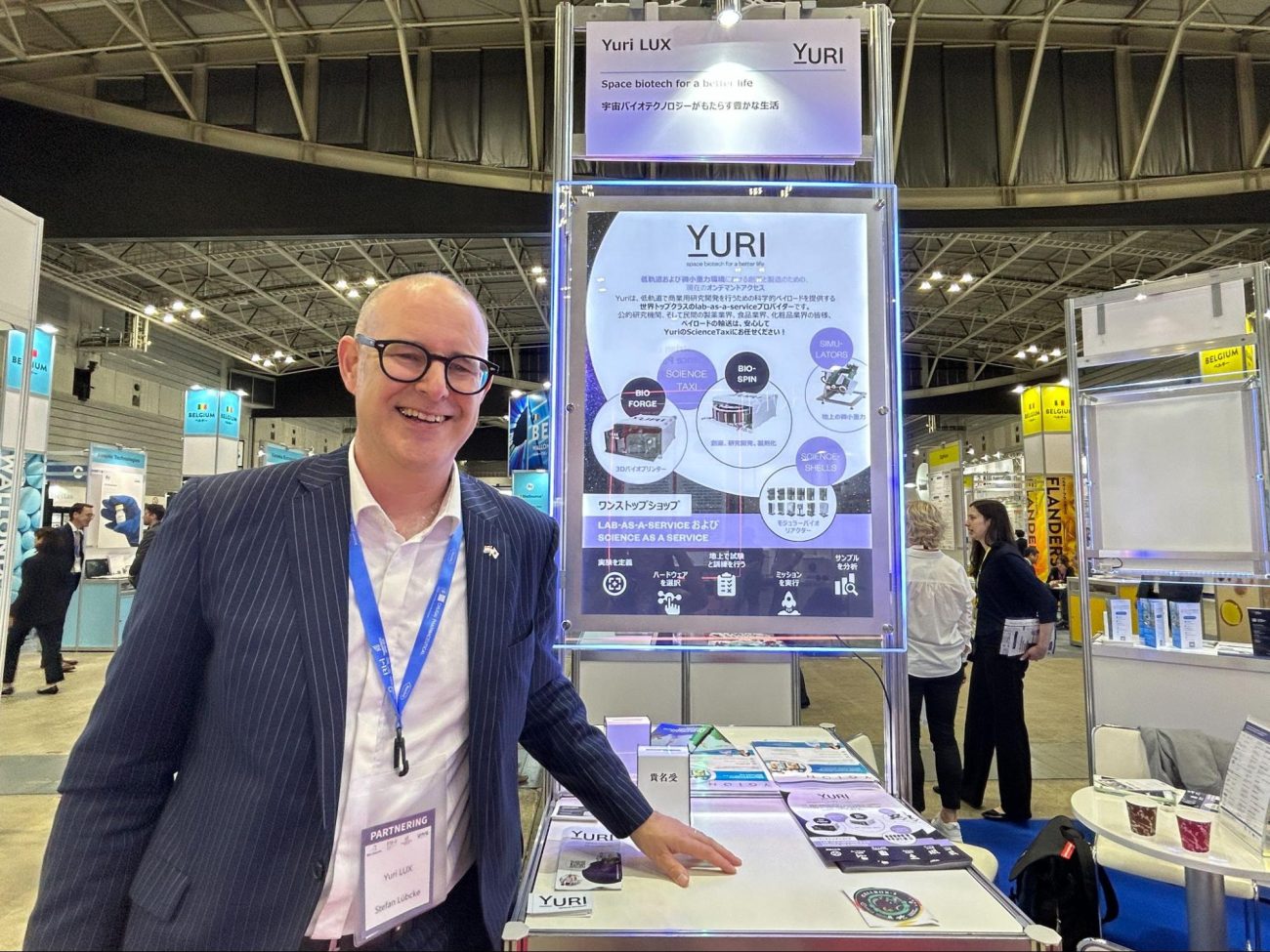
We interviewed Mr. Stefan Lübcke, Managing Director Yuri LUX GmbH, who was visiting Japan to exhibit at a booth at the “BioJapan” exhibition held in Yokohama, to ask about the overview of the business and his expectations for the Japanese pharmaceutical market.
Founded by Two Former Airbus Employees
—Please tell us about the background of the company’s founding.
Yuri Gagarin, the first human to go to space has inspired the founders Maria Birlem (Co-Founder & Co-CEO) and Christian Bruderrek (Co-Founder & COO)to call their company “Yuri”. Both of them had been involved in space-related work at Airbus for many years. What they had in common was the desire to “go to space” and “do something good in space.” The company has coined the slogan“we do space tech for a better life.”
Maria, in particular, originally admired jet pilots. However, during her training, she learned about the existence of launch vehicles and felt “a launcher is much faster and much more powerful than jets.” From there, she chose the path of learning space technology and working with launch vehicles. At that time, it was not yet an era where SpaceX or Falcon rockets were commonplace, but she still thought, “I want to make something where you can take good from space and to deliver it to earth”.
What we at YURI are looking at are fields such as medicine andpharmaceuticals, agriculture and food development and cosmetics and anti-aging products. For these industrial domains, Yuri provides insights, scientific findings and commercializable results that can only be obtained because of the microgravity environment. There is great room for space to contribute to global issues such as sustainability, health, and food problems. YURI is a company born from these ideas.
—Where are your business bases located?
Our headquarters is located near Lake Constance in Southern Germany. It is near an Airbus base, a region where the founders worked for many years. In 2020, YURI established another base in Luxembourg. The distance from southern Germany to Luxembourg is about a 6-hour drive, but the teams cooperate closely in digital team sessions.
Luxembourg is a country that has been highly evaluated in the space technology field. Following the establishment of the satellite communications company SES in 1985, the country has nurtured the space industry as a national strategy through joining the European Space Agency (ESA) and establishing the Luxembourg Space Agency (LSA). Currently, more than 90 space-related companies are concentrated there.
Against the backdrop of this space industry ecosystem and government backing, founders Maria and Chris positioned Luxembourg as a base for international business expansion. YURI established its base in Luxembourg in July 2020 and celebrated its 5th anniversary in 2025. To mark that milestone, we held an event with customers, scientists and incubators to introduce a use case how space-engineered compounds can cure contaminated soil in the wine-making industry.
Currently (at the time of the interview), YURI Luxembourg has 11 members. The 30-ppeople team around Lake Constance in Southern Germany handles the technical aspects utilizing years of space development experience, while Luxembourg handles the manufacturing, integration, testing, and service of the Science Taxi. The two bases advance the business in coordination through repeated online meetings and mutual visits.
Experiment Platform: Aiming for Monetization Within 5 Years
—Why are research and experiments in a microgravity environment attracting attention?
In the microgravity environment of low earth orbit, experiments can be conducted under conditions unavailable on the ground. The biggest difference is, of course, gravity,cosmic radiation being another influenctial factor. Cell structures that would collapse under the influence of gravity on the ground can grow stably under microgravity. Another characteristic is that the progress of experiments is fast. It is known that aging is accelerated in space, and as a result, changes that would take a long time to observe on the ground can be captured in a shorter period. Furthermore, physiological reactions that are difficult to simulate on the ground, such as stress on mitochondria, also occur.
Such an environment brings new results not only for pharmaceuticals but also for the cosmetics and food sectors. Just as unexpected results can be obtained by conducting research in extreme environments like the deep sea or volcanoes, space is also a place that provides new perspectives for product development on the one hand.
On the other hand, there are challenges. That is, many in the decision-making layer do not yet know enough about microgravity experiments. When talking to decision-makers, it is not uncommon for them to hear the word “microgravity” for the first time. What YURI is working on is bridging this information gap. Interest in bio-research in space is rising among scientists. The challenge is bridging the gap to the industrial world.
So far, YURI has discovered many use cases through more than 160 experiments, centering on fields such as cancer, neurodegenerative diseases, and tissue engineering. Tissue modeling with 3D bioprinters and protein crystallization are examples of this. What is required going forward are industrial partners who will take the step toward actual product development based on these insights.
—What kind of products are “Science Taxi” and “Science Shell”?
The service that forms the core of YURI’s business is “ScienceTaxi.” As the name suggests, ScienceTaxi is space flight hardware that transports scientific experiment payloads like a “taxi,” designed to integrate everything from launch to experiment and return. It supports a wide range of bio-experiments including plant biology, cell biology, bacteria, and human cells, and is characterized by its ability to provide an experimental environment with a wide temperature range of 4 to 40 degrees. ScienceTaxi is automated and does not require expensive astronaut work time. Remote operation and control from the ground are possible, and YURI as a one-stop shop also handles the software development.
During a launch by Northrop Grumman (NG-23), a situation occurred where timely docking to the ISS was delayed due to trouble with the propulsion system. At that time, ScienceTaxi already produced scientific data autonomously for 4 days without connecting to the ISS. The fact that it secured power outside the ISS and was able to operate independently served as a result proving the functionality of ScienceTaxi. These characteristics will connect to space utilization after the end of ISS operations. ScienceTaxi is also already now booked for missions on VAST’s “Haven-1,” a private commercial space station to start the post-ISS era already now.
Inside the ScienceTaxi, 38 experiment incubators, “ScienceShells” are installed. A ScienceShell can be flexibly customized according to customer needs. It becomes possible to transport experimental samples and conduct experiments at a significantly lower cost and in a shorter period than before. For example we design and manufacture millifluidic systems with 3D printing, and it is also possible to incorporate microscopes or LED lighting for plant experiments. When carrying organisms like zebrafish or fruit flies, we design the entire experiment including nutrient supply.
We call this comprehensive provision from design to integration and operation “lab-as-a-service.” Our ideal is that researchers and companies can concentrate on their experiments themselves without being conscious of detailed spacecraft design.
—Please tell us YURI’s strengths when compared to competitors.
There are various companies in the world that provide services similar to ScienceTaxi. For example, ICE Cubes Nanoracks and Space Tango are representative players offering experimental opportunities in space. We at YURI differentiate ourselves by combining ScienceTaxi and ScienceShells as highly customizable Lab-as-a-Service.The centrifuge on our ScienceTaxi allows to compare microgravity to other forms of gravity (earth, lunar or martian) on one and the same experiment platform.
So far, YURI has sent over 160 experiments to space with more than 60 customers. Our partners include universities in Europe, Asia, and Australia. Many scientific papers have already been published in fields such as the oncology, organoids, retina production, and plant biology. While accumulating these achievements, we intend to expand usage not only for research purposes but also to more commercial customers.
—Please tell us your future milestones.
Having finished the maiden flight of ScienceTaxi, what we at YURI are aiming for is the establishment of a regular flight service. While having space agencies as customers, we want to fully roll out “lab-as-a-service” as a commercial model also to private industry.
Specifically, we envision a cycle of launch, experiment, data acquisition, service provision, and refurbishment of the unit, aiming to launch ScienceTaxi at least twice a year. In addition to the currently operating “BioSpin,” a new unit called “BioForge ” equipped with a 3D bioprinter is also incorporated into this roadmap. Our goal is to establish stable revenue from “Lab-as-a-Service” within the next 5 years.
A Keen Eye on Japanese Pharmaceutical Companies
—What are your thoughts on regulations when proceeding with R&D in space?
I wish the acceptance of Lab-as-a-Service in the pharmacuetical industry increases and the approval processes necessary for experiments and research will become faster. The speed of approval by regulatory authorities is important to shorten the time it takes to reach an R&D contract. We are working to meet safety requirements for all launch providers, but on top of that, regulatory responses also need to be swift.
Another important point is how medical regulatory authorities accept R&D conducted in space. It is essential to have authorities such as the Japan Pharmaceutical Manufacturers Association (JPMA), the European Medicines Agency (EMA), and the US Food and Drug Administration (FDA) evaluate Research and Development (R&D) conducted in space. This will be the foundation for rolling out “Lab-as-a-Service” to private companies.
—What impression do you have of the Japanese pharmaceutical market?
We see that Japan has both large market and a very large innovative potential. The Japanese pharmaceutical market is the third largest in the world, and it is also a country with a long history of elderly care. Additionally, Japan has experienced the accident at the Fukushima Daiichi Nuclear Power Plant. From the perspective of protection against and treatment of radiation damage, we believe research results from space have the potential to be useful to society.
During this visit to Japan, I visited innovation hubs in Osaka and Tokyo and also heard about the bio-cluster in Kobe. Japan has high-level researchers and research environments. By working together with such researchers, we want to create better products and commercial products with a higher degree of perfection.
Also, I witness that Japan is a country where the approval process in the pharmaceutical field is very fast. I recently learned that the average time for approval of new active ingredients is about 290 days in Japan, whereas it often exceeds 400 days in the US, Europe, and Switzerland. The speed of the approval process is important. If regulatory response is fast, research results obtained in space can be delivered to the market sooner. We believe that by leveraging this environment in Japan, we can create further value in the pharmaceutical field.
—What expectations do you have for Japanese companies?
We definitely want to collaborate with Japanese pharmaceutical companies on R&D in low earth orbit. We would like them to entrust their scientific payloads to us using our cutting-edge “Lab-as-a-Service” and proceed together, initially as a pilot project. We want to make that a continuous initiative rather than ending it with just one time.
For the pharmaceutical industry, the target fields are oncology,ophtalmology, neurodegenerative diseases, diabetes, and organoid research. The pharmaceutical industry is large in scale and has significant social impact.
I also see a strong potential for the world-leading Japanese cosmetics industry for enhancing their innovative anti-aging products by using Yuri’s Lab-as-a-Service for commercial R&D.
We expect this field to take an interest in R&D utilizing space and to actually begin taking action.