
【Year in Review 2025-2026】Over 100 Space Business Companies Reflect on 2025 Topics and 2026 Outlook
In 2025, we compiled responses from over 100 space-related companies operating in Japan for our annual "Year in Review" survey! This article also includes market forecasts from each company for 2026.
Please note that this document has been machine-translated from the original Japanese text, and we cannot guarantee its accuracy.
Introduction
What kind of year was 2025 for you, our readers?
This year was another remarkable year marked by SpaceX’s continued advancement. Their 123-meter-tall reusable rocket “Starship” launched five times, with the final launch of the year achieving a perfect success as planned. If all goes smoothly, satellite deployment into orbit is scheduled for next year. Additionally, Starlink, also operated by SpaceX, surpassed 9 million users. Considering there were 4.6 million users in December 2024, this represents nearly a doubling.
Planet Labs, which leads the world in building a constellation of Earth observation satellites equipped with optical sensors, reached adjusted EBITDA profitability (a metric measuring core business cash generation, excluding taxes, interest, and depreciation) for four consecutive quarters. Large-scale contracts with government agencies, primarily for national security applications, have been key to this growth.
Turning to Japan, 2025 saw the H-IIA rocket’s final flight in June successfully launch “GOSAT-GW (Ibuki GW),” marking the successful conclusion of its distinguished service. The baton will now pass to its successor, the H3 rocket, as Japan’s flagship launch vehicle.
The H3 rocket successfully launched “Michibiki-6” on February 2, 2025, and the “New Space Station Resupply Vehicle Unit 1 (HTV-X1)” on October 26. However, the December 22 launch of “Michibiki-5” failed when the second-stage engine experienced combustion issues, preventing proper orbital insertion. Investigation into the cause is currently underway, with hopes for an early resumption of launches.
Also in 2025, Sanae Takaichi, who has experience as Minister responsible for Science and Technology Policy, Space Policy, and Economic Security, became Japan’s first female Prime Minister. Six fields were selected as National Strategic Technologies, with space being one of them. The Space Strategy Fund also announced the results of its second round of theme selection and adoption, increasing attention to space technology development as a national policy.
Regarding developments in Japan’s private sector, Axelspace went public in August. This marked another IPO for a company that has led Japan’s space startups since the era when the “NewSpace” movement gained momentum in Japan.
The number of companies that responded to this year’s “Year in Review” survey exceeded 100. In Japan, if we consider companies like Axelspace, ispace, iQPS, Synspective, and Astroscale that led NewSpace as the first generation, we are now seeing the emergence of second and third generation space startups, as well as increased space industry participation from companies previously unrelated to the space sector.
A symbolic moment was when Takayoshi Fukuyo of ArkEdge Space ranked first in the Forbes JAPAN January 2026 issue’s “Japan Entrepreneur Ranking 2026” feature, published on November 25, 2025. This was major news that energized Japan’s space industry at year’s end. In the past, Mitsunobu Okada of Astroscale also received this honor in the “Japan Entrepreneur Ranking 2019.”
Furthermore, visitors to the Osaka-Kansai Expo, which began in April 2025 and was held over six months, likely witnessed various countries’ exhibitions themed around space development and felt that space development is becoming increasingly practical and relevant to everyday life, not just aspirational.
Since 2020, Sorabatake has conducted an annual survey titled “Space Business Year in Review” where we ask various space business companies to reflect on the past year and share their aspirations for the new year, introducing our readers to the developments and vitality of the space business!
For this year’s survey, despite the busy year-end season, we received responses from a total of over 100 companies and organizations. We would like to express our sincere gratitude to all who participated.
*The number of responding companies will be updated as needed after article publication.
Related Articles
・2024
・2023
・2022
・2021
・2020
For this sixth annual survey, we asked four main questions:
・2025 Topics
・Regarding customers and value provided: actual examples and ideal use cases you aim to pursue in the future
・Aspirations for 2026
・Recruitment information (optional)
We also asked about expectations for how the space business market size and investment amounts will change in 2026.
We hope you enjoy this article as you reflect on the year and look ahead, discovering “how far this company’s plans have progressed,” “this company was also doing this,” and “looking forward to next year.”
You can view detailed responses from each company here.
*Please note that this survey was completed by each company by the December 10, 2025 (Wednesday) deadline, and some content may not reflect the latest developments.
This article was produced with the kind sponsorship of the companies featured. We are deeply grateful for your warm support. The funds provided through sponsorship will be gratefully utilized to plan and produce better articles that contribute to the development of Japan’s space industry.
(1) Introduction of Space Business Companies That Responded
Below, we have organized the companies and organizations that responded to this survey by their main service areas.
(Titles omitted, in alphabetical order by Japanese name)
◆ Manufacturing, Infrastructure & Components
ArkEdge Space Inc.
IHI Corporation
AstreX Inc.
AstroX, Inc.
ISE Corporation, Inc.
Idemitsu Kosan Co., Ltd.
Interstellar Technologies Inc.
Infostellar
EBARA CORPORATION
NPO e-SET (enjin SPACE ENGINEERING TEAM)
Orbital Lasers Co., Ltd.
Axelspace Corporation
WARPSPACE Inc.
Kick Space Technologies Inc.
Institute for Q-shu Pioneers of Space, Inc. (iQPS)
Cislunar Technologies Inc.
Innovative Space Carrier Inc.
Synspective Inc.
SKY Perfect JSAT Holdings Inc.
Space Compass Corporation
Toyota Motor Corporation
NEC Corporation
PD AeroSpace, LTD.
Fujitsu Limited
Fusic Co., LTD.
MJOLNIR SPACEWORKS Co., Ltd.
YUMOTO ELECTRIC INC
Letara Ltd.
◆ Utilization (Earth Observation Data, Positioning Information, Space Environment Utilization, etc.)
AOZORA Inc.
Agriee K.K.
Agri-Light Lab. Inc.
Archeda, Inc.
WHERE, Inc.
Space Service Innovation Laboratory (SSIL)
Umitron K.K.
Satellite Data Services Co., Ltd.
ALE Co., Ltd.
Exspace, Inc.
NSW Inc.
OEC Co. Ltd
Oppofields LLC
Gaia Vision Inc.
Green & Life Innovation, Inc.
GLODAL, Inc.
Sagri Co., Ltd
Space Shift Inc.
Space Tech Accelerator Inc.
Smart Link Hokkaido Co., Ltd.
SoftBank Corp.
Digion, Inc.
Tellus Inc.
Japan EO Satellite Service,ltd(“JEOSS”)
New Space Intelligence Inc.
PASCO CORPORATION
HALEX CORPORATION
Helios Inc.
Penguin Labs
Matsushima Construction Co., Ltd.
Marble Visions Inc.
MIERUNE Inc.
Japan Manned Space Systems Corporation (JAMSS)
YuMake Inc.
LAND INSIGHT
Ridge-i Inc.
Remote Sensing Technology Center of Japan (RESTEC)
◆ Expansion of Human Space Activities
Amateras Space, Inc.
ElevationSpace Inc.
TOWING Co., Ltd.
JGC Corporation
Fuseki Inc.
◆ Space Sustainability
Astroscale Holdings Inc./ Astroscale Japan Inc.
Orbital Lasers Co., Ltd.
BULL Inc.
◆ Human Resources & Education
Invite you Inc.
sorano me Inc.
for Startups, Inc.
Levii Inc.
◆ Trading Companies & Consulting
ASTRO GATE Inc.
Ernst & Young ShinNihon LLC
INDUSTRIAL-X.
KPMG Consulting Co., Ltd.
SEESE Inc.
Space BD Inc.
Mitsubishi UFJ Research and Consulting Co., Ltd.
minsora Inc.
Rikei Corporation
◆ Insurance
Tokio Marine & Nichido Fire Insurance Co., Ltd.
◆ Non-Profit Organizations & General Incorporated Associations
cross U
SPACETIDE Foundation
Space Port Japan Association
General Incorporated Association Space Medical Accelerator
◆ Media, Content & Entertainment
ALTILAN Inc.
CROSS ARCHITECTS,INC.
Nippon Television Network Corporation
Bascule Inc.
4X Corp. (UchuBiz)
◆ Other
Development Bank of Japan Inc.
Mitsubishi Logistics Corporation
(2) Key Highlights of 2025
Before introducing each sector, here are some highlights from this year’s survey that caught the attention of the Sorabatake editorial team!
1. Space Strategy Fund and Private Investment as Catalysts for Japan's Space Technology Development
The Space Strategy Fund began soliciting various space technology development projects in 2024. With companies selected in the first round beginning their activities, the term “Space Strategy Fund” appeared frequently in company responses.
Additionally, there was news of well-known Japanese companies investing in space startups, such as Woven by Toyota’s 7 billion yen Series F investment in Interstellar Technologies, and Nippon Television Network’s investment in Frontier Innovations’ space deep tech fund. Space business companies like SKY Perfect JSAT also announced capital and business alliances with “WHERE,” which supports real estate transactions from space, and “Green Carbon,” which operates a carbon credit creation business, accelerating private sector investment in the space industry.
While not limited to the space business, people, resources, and capital are essential for creating businesses. Funding is crucial for taking the first step and continuing technology development, and the space business is an industry that particularly requires significant initial investment. It felt like a year where funding began to accumulate as the space industry was recognized as an important national investment field and an industry in which private companies place expectations.
2. Various Human Resources Needed in the Space Industry
In this survey, we asked each company an optional question: “Please tell us about your recruitment status and the type of talent you seek.” As a result, 70% of companies provided information about their recruitment status and desired talent profile, despite this being optional.
With the launch of the Space Strategy Fund, IPOs of space startups, and an increase in space startup launches in recent years, human resources in the space industry have become essential.
This year also saw SPACETIDE Foundation, which hosts Japan’s largest international space business conference “SPACETIDE,” launch “SPACETIDE Academy” as a new business—a basic space business training program for those changing careers to or entering the space industry.
Additionally, career support for transitioning to the space industry appears to be becoming more active, with companies like Invite you, a recruitment agency specializing in the space industry, and for Startups,Inc., an agency specializing in startups.
For details on each company’s recruitment status, please check the
detailed response PDF.
3. Co-Creation and Joint Research: Key Keywords for 2025
One keyword that caught the Sorabatake editorial team’s attention in many company and organization responses regarding 2025 reflections and 2026 aspirations was “co-creation and joint research.”
Regarding SKY Perfect JSAT’s capital and business alliances with space startups mentioned earlier, the response stated that startup co-creation was the purpose and they plan to accelerate this movement going forward.
SPACETIDE Foundation’s response—”In 2026, we aim to make the international space business conference ‘SPACETIDE 2026’ a place where people from more diverse countries, regions, and industries than ever before can co-create”—also shows that creating spaces for co-creation will continue to be an important theme.
Additionally, cross U, which operates under the concept of a space industry co-creation platform to create and expand connections between non-space companies/organizations and the space industry while supporting the further growth of the expanding space industry, exceeded 340 members and held over 270 member-hosted events per year. The organization responded that it will further enhance the content of “NIHONBASHI SPACE WEEK,” which it operates, and promote the creation of co-creation examples.
So what kind of co-creation and joint research emerged in 2025?
One example is the formal partnership between Toyota Motor Corporation and Woven by Toyota with Interstellar Technologies for launch vehicle development, as mentioned earlier. The news brought great expectations for the evolution of space transportation technology in Japan by leveraging the Toyota Group’s manufacturing expertise cultivated over many years in launch vehicle development.
Additionally, co-creation and joint research are not just about collaborations between large companies and space startups. Amateras Space, which unveiled the next-generation spacesuit “VESTRA” using Nishijin textiles at the Osaka-Kansai Expo, responded: “Through joint research with Professor Yamashiki of Kyoto University and Professor Tanaka of Gifu University of Medical Science, we were able to further establish our position as a startup leading human space development.” This suggests that co-creation between space startups and academia is expected to accelerate in the future.
Infostellar, which provides ground station sharing services, announced partnerships with global GSaaS providers in quick succession: Dhruva Space from India in March, CONTEC from South Korea in June, and Leaf Space from Italy in October. This has dramatically expanded their ground station provision capabilities globally in both quantity and quality.
ArkEdge Space participated in summit-level events such as TICAD9, COP30, and the Central Asia Summit, signing 25 memoranda with 10 countries focused on satellites and data utilization, accelerating their global expansion.
Furthermore, Space Tech Accelerator, which was selected for technology development in the Space Strategy Fund’s second round theme “Overseas Demonstration of Satellite Data Utilization System (Feasibility Study)” for “Development of Palm Farmer Support App Using Satellite Data Contributing to Sustainable Procurement,” reflected on 2025: “We began user testing at agricultural cooperatives managing 400 farmers, clarifying the implementation feasibility of ‘field collaboration intelligence technology’ connecting farms to procurement companies. Additionally, our collaboration system with local institutions and government has made significant progress.” Their 2026 aspiration is “to aim for establishing a system that can co-create the ‘ideal form’ of industrial structure by discussing what supply chains should be globally, including Europe and America, in addition to collaboration with Japanese companies.”
In 2025, various forms of co-creation and joint research emerged: large companies with space startups, space startups with academia, domestic space companies with overseas space companies, space-related companies with customers using space-based business, and space-related companies with foreign governments.
(3) Manufacturing, Infrastructure & Components Sector
The Manufacturing, Infrastructure & Components sector introduces companies that play an indispensable role in advancing the space business by supporting the industry’s foundation.
For example, satellites need launch vehicles to transport them to space to operate there, and for data observed by satellites to be usable on Earth, there must be some means of transporting (communicating) data from satellites to ground-based internet connections.
This sector also includes satellite manufacturing, of course, as well as parts, components, and materials needed when developing launch vehicles and satellites, facility provision for environmental testing, and software development for operating spacecraft as planned.
The following companies responded to the survey in this sector:
===
ArkEdge Space Inc.
IHI Corporation
AstreX Inc.
AstroX, Inc.
ISE Corporation, Inc.
Idemitsu Kosan Co., Ltd.
Interstellar Technologies Inc.
Infostellar
EBARA CORPORATION
NPO e-SET (enjin SPACE ENGINEERING TEAM)
Orbital Lasers Co., Ltd.
Axelspace Corporation
WARPSPACE Inc.
Kick Space Technologies Inc.
Institute for Q-shu Pioneers of Space, Inc. (iQPS)
Cislunar Technologies Inc.
Innovative Space Carrier Inc.
Synspective Inc.
SKY Perfect JSAT Holdings Inc.
Space Compass Corporation
Toyota Motor Corporation
NEC Corporation
PD AeroSpace, LTD.
Fujitsu Limited
Fusic Co., LTD.
MJOLNIR SPACEWORKS Co., Ltd.
YUMOTO ELECTRIC INC
Letara Ltd.
===
Technology Development Progressing at Each Company Toward Over 30 Annual Launch Vehicle Launches from Japan
Currently, theSpace Strategy Fund Basic Policyaims to secure national launch capability of approximately 30 launches per year by the early 2030s.
As introduced at the beginning, the H-IIA launch vehicle’s 50th flight in 2025 served as its final launch, ending with distinction. While Mitsubishi Heavy Industries led overall H-IIA development, the IHI Group developed and manufactured the solid rocket boosters (SRB-A), turbopumps for rocket engines, second-stage gas jet devices (attitude control systems), pyrotechnics, and onboard rocket cameras. The IHI Group is also developing and manufacturing similar components for the H3 launch vehicle. Furthermore, they stated their aspiration as a company supporting Japan’s flagship launch vehicles (transportation systems essential for ensuring domestic retention and transportation system autonomy to achieve government missions centered on national security): “We will continue to work steadily toward the early resumption of Epsilon launch vehicle launches.”
However, for the early 2030s launch target, flagship launch vehicles alone are considered capable of only about 10 launches per year, making private launch vehicle utilization essential to cover the remaining 20 launches. Therefore, launch vehicle development and launch site preparation by private companies are rapidly advancing.
In addition to the already-mentioned Interstellar Technologies, private companies such as AstroX, Innovative Space Carrier, Space One, and PD Aerospace are advancing launch vehicle development.
AstroX, which holds the vision “Regain ‘Japan as No.1’ in space development,” reflected that it was a year when they “accelerated talent recruitment and partner collaboration through 1.8 billion yen fundraising in Series A Round 1st Close, and began full-scale preparation toward reaching space in 2026.” Their 2026 aspiration is “a year to complete Rockoon system integration testing and technology demonstration toward reaching space.”
Innovative Space Carrier stated they were able to “deepen collaborations necessary for reusable rocket development and future commercialization,” providing specific examples such as “securing a base for launch vehicle manufacturing, assembly, and testing in collaboration with JFE Engineering and Asahi Kasei” and “concluding a ‘business alliance contract toward the commercial phase of space travel services’ with JTB.” The response from Letara, which develops hybrid engines and will be discussed later, also mentioned Innovative Space Carrier’s name, demonstrating progressing collaboration strengthening.
PD Aerospace reflected on 2025 as when they “began implementing service provision by undertaking development for other space startups and research institutions, leveraging developed capabilities and technical strength accumulated while conducting new R&D-based development.” Their 2026 aspiration is “completion of a new engine and start of sales (orders),” also mentioning commercialization of accumulated knowledge and technical capabilities.
Three companies—EBARA CORPORATION, Letara, and MJOLNIR SPACEWORKS—responded that they are conducting development related to rocket engines.
EBARA CORPORATION completed actual liquid (fuel: liquid methane, oxidizer: liquid oxygen) operation tests for electric turbopumps for rocket engines. Letara succeeded in rapid development of hybrid rocket engines and satellite engines. MJOLNIR SPACEWORKS achieved high-frequency rocket engine combustion testing, demonstrating steady technology development progress.
Furthermore, ISE Industries, which has been involved in Japan’s flagship launch vehicles and has strengths in pipe processing for medium-diameter aluminum materials up to 4.5 inches in diameter, reported that based on achievements with the H3 launch vehicle, they have begun development cooperation with several domestic small launch vehicle startups. Manufacturing technology that Japan has cultivated through various industrial products is becoming the foundation that accelerates Japan’s space industry growth.
Companies' Satellites Launched One After Another; New Satellite Development and Mass Production Also Accelerating
2025 was a year when satellites involving Japanese private companies were launched one after another.
Additionally, NEC’s positioning mission payload is installed on Michibiki. NEC published “he Science of Artificial Satellites, Revised Edition,” in August 2025. For those who want to learn about satellite mechanisms and roles along with somewhat deeper technical details, it might be worth considering a purchase.
iQPS, which is advancing small SAR satellite constellation construction, has been steadily conducting operations and initial operations, launching satellites in succession starting with Unit 9 in March, followed by launches in May, June, August, and November. They also succeeded in a launch on December 21.
The NPO Space Engineering Team (NPO e-SET(enjin SPACE ENGINEERING TEAM)), based in Kyushu and involved in cutting-edge industry fields since 2007, responded that in 2025 they manufactured mechanical systems for iQPS satellites.
Synspective, which like iQPS develops small SAR satellites, also successfully launched their 7th third-generation SAR satellite. Furthermore, they concluded a multi-launch contract with Rocket Lab for a total of 20 satellites, steadily advancing plans toward constellation construction.
When Rocket Lab CEO Peter Beck visited Japan, we asked him about the future potential of Japanese space companies and markets, and received the following response:
“Japan is a very important market for us. Synspective is an important customer, and we’ve launched satellites for iQPS and Astroscale.” “What Japanese space companies have in common is that they’re doing innovative and unique things that haven’t been done before.” “I think Japan’s space industry is in an entrepreneurial beginning period. We at Rocket Lab work with companies in countries around the world, but we’re experiencing rapid growth in Japan’s space market and the high quality of companies.”
Being able to hear overseas evaluation of Japan’s space industry directly was a very valuable experience for Sorabatake that remains vivid in our memory.
For space companies involved in Earth observation satellites equipped with optical sensors, Axelspace launched the “GRUS-3α” performance verification satellite for their next-generation Earth observation satellite “GRUS-3” in June 2025. They announced plans to launch 7 GRUS-3 satellites within 2026.
Marble Visions Inc. was selected for the Japan Aerospace Exploration Agency’s (JAXA) Space Strategy Fund 1st Phase technology development theme “Optical observation satellite system with high resolution/high frequency,” and officially started their project in April 2025. Expectations are rising for high-resolution, high-frequency 3D spatial information and digital twin platforms.
Furthermore, ArkEdge Space Inc. developed 7 of their own satellites in parallel, succeeding in on-orbit demonstration for all of them. With ONGLAISAT, they achieved world-class GSD(2.5-3.0m) for a 6U satellite, succeeded in capturing hyperspectral images with AE2a, and succeeded in receiving AIS signals with their VDES satellite… demonstrating their ability to develop satellites for various missions.
“In 2026, we want to make it a year to further accelerate concrete efforts toward constellation construction based on the achievements of demonstration satellites obtained in orbit in 2025. We will refine our development and operation systems premised on multi-satellite operation and advance infrastructure building to provide satellite data stably and continuously,” they shared as their aspiration.
Also, new companies involved in spacecraft development emerged. Kick Space Technologies Inc. was founded in 2025 as a Kyushu Institute of Technology university-backed startup, providing design and manufacturing services for ultra-small satellites to customers.
Toward Strengthening Japan's Supply Chain and Commercialization as Described in Space Technology Strategy
As with ISE Industries mentioned above, domestication for stable supply of important parts and components in launch vehicle and satellite development has been attracting attention in recent years from an economic security perspective.
In this area, Idemitsu Kosan responded that “results of long-term incubation are finally becoming visible to everyone.” The space CIGS solar cells they are developing are characterized by extremely high radiation resistance. They are expected to contribute to extending spacecraft lifespans and more radiation-harsh orbital applications (such as medium orbit).
Additionally, AstreX Inc., which has many achievements with satellite battery units, PCU, and PDU, stated: “2025 is considered the year when social implementation of space technology through satellite utilization began in earnest, so we newly deployed activities to widely inform people about our company’s space technology information, which had been provided to limited customers, such as website renewal and exhibition participation.” They provided comments where we could tangibly feel the expansion of the space industry, such as providing even greater value to customers through quality assurance and production system strengthening while enhancing existing technology for 50-100kg class small satellites.
Additionally, Yumoto Electric manufactured and delivered parts to Iwaya Giken, which is working on space tour services by balloon. The company’s space division is operating under the trademarked name “Stella Mechanics.” They also exhibited for the first time at NIHONBASHI SPACE WEEK 2025, and told us that listening to visitors’ stories made them “feel even more attention and future potential of the space industry,” having a year where they could see the possibilities of the space industry.
Cislunar Technologies had the TSUKIMI project, in which they are participating in lunar orbiting satellite bus development, selected for Space Strategy Fund Round 1, and it has been decided that it will actually be transported to the Moon onboard ispace’s lander.
Furthermore, Pale Blue, which develops water-based thrusters for small engines, reflects on 2025 as “a year when space demonstrations occurred in succession.” The company celebrated its 5th anniversary this year, and in the interview, CEO Dr. Asakawa told us about the importance of space demonstrations, such as how having space demonstration achievements leads to gaining trust from overseas companies and enables commercialization prospects.
This year also saw the launch of a new program, the JAXA Space Technology Acceleration Program (JAXA-STEPS), which reorganized JAXA’s Research and Development Directorate’s “Innovative Satellite Technology Demonstration Program” and “Agile Research Program for Advanced Technology in Satellite Service and Process,” as well as the Business Development and Industrial Relations Department’s “Industry-Academia-Government Transportation and Microsatellite Mission Enhancement Program (JAXA-SMASH).”
Additionally, Axelspace plans to launch and conduct on-orbit demonstration of ASPINA Shinano Kenshi’s reaction wheel, which they have been jointly developing since 2020. They shared their 2026 aspiration: “We will continue to leverage our technology and experience to the fullest to respond to the rapidly expanding needs for early on-orbit demonstration of space components.”
Through JAXA’s initiatives and private business activities, space demonstration opportunities are increasing, and there are expectations that Japan-origin space parts and components will not only be used in Japan but will flourish as a business sought after from overseas.
Growing Importance of Areas Accelerating Space Industry Growth: Launch Sites, Ground Station Facilities, Software Development...
While we have introduced launch vehicle and satellite development and parts/components, for services utilizing space introduced from the next chapter onward to be provided to us, many companies with roles beyond the manufacturing companies typically imagined when hearing “space business” are indispensable.
One such area is launch sites for launching launch vehicles into space. ASTRO GATE, which conducts R&D on launch facility efficiency and advances spaceport planning worldwide, developed a remote launch site operation system utilizing Starlink. They plan various deployments such as video surveillance in remote areas and IoT operations.
Also, without ground stations, launch vehicles and satellites cannot be operated. Infostellar, which operates a ground station sharing service that has partnered with various overseas companies, shared their aspiration: “In 2026, we will make it a year to properly deliver to customers as actual services, not just keeping the strategic partnerships we have built to mere preparation and infrastructure development.”
Furthermore, attention is gathering not only on communication between satellites and ground but also communication between satellites deployed in space. WARPSPACE Inc. was selected for the Space Strategy Fund Round 2 technology development theme “Development of Inter-Terminal Interconnection Technology for Introduction and Expanded Use of Satellite Optical Communication.” Their 2026 aspiration stated that for optical modems and digital twin systems, they aim to conduct demonstration tests and achieve multiple sales contracts with those results, with a mid-term goal of achieving profitability through IPO by steadily building sales performance.
Additionally, Space Compass Corporation also acquired a Ministry of Defense contract toward optical data relay satellite demonstration in April 2025, advancing business development toward establishing highly reliable, high-speed communication in orbit. They shared their aspiration to launch a GEO optical data relay satellite within several years and start highly reliable, high-speed communication services in orbit.
Fujitsu Limited, with orbital technology and ground operation technology evolved into advanced and efficient satellite operation infrastructure as their value proposition, has accumulated many achievements. In 2025, they established the Space Business Promotion Office and FDNS Space Solution Business Division, consolidating space engineers. Within the company, they built a structure to accelerate space business with three organizations in security, private, and R&D fields.
Fusic Co., LTD., which supports various space companies in the “space and cloud” domain, reflected on the year: “By sharing knowledge of AWS-based cloud environment construction, data analysis, and system integration, which are our strengths, with the industry and deepening mutual understanding, we were able to draw a clear roadmap for space business expansion.”
Indeed, it seems to have been a year when they increased their presence in the space industry as cloud-proficient professionals through corporate partnerships with Astroscale, participation in the AWS Accelerator Program, and partnerships with Kick Space and Infostellar.
(4) Satellite Utilization, Satellite Data Provision & Platforms
The Satellite Utilization sector introduces companies involved in providing services to improve life on Earth by utilizing communication satellites, positioning satellites, and Earth observation satellites.
While the space industry often evokes images of launch vehicles and space exploration, the reality is that both now and in the future, service deployment on Earth utilizing space technology and its ripple effects account for much of the market size.
Success in monetizing companies in the satellite utilization sector and generating demand for satellite use will ultimately increase demand for launch vehicle and satellite development and heighten the importance of space sustainability. In other words, it is no exaggeration to say that the success of the satellite utilization sector determines the fate of the entire space industry.
So what kind of year was 2025 for companies involved in expanding and developing satellite utilization services in Japan? The following companies responded to this survey:
===
AOZORA Inc.
Agriee K.K.
Agri-Light Lab. Inc.
Archeda, Inc.
WHERE, Inc.
Space Service Innovation Laboratory (SSIL)
Umitron K.K.
Satellite Data Services Co., Ltd.
ALE Co., Ltd.
Exspace, Inc.
NSW Inc.
OEC Co. Ltd
Oppofields LLC
Gaia Vision Inc.
Green & Life Innovation, Inc.
GLODAL, Inc.
Sagri Co., Ltd
Space Shift Inc.
Space Tech Accelerator Inc.
Smart Link Hokkaido Co., Ltd.
SoftBank Corp.
Digion, Inc.
Tellus Inc.
Japan EO Satellite Service,ltd(“JEOSS”)
New Space Intelligence Inc.
PASCO CORPORATION
HALEX CORPORATION
Helios Inc.
Penguin Labs
Matsushima Construction Co., Ltd.
Marble Visions Inc.
MIERUNE Inc.
Japan Manned Space Systems Corporation (JAMSS)
YuMake Inc.
LAND INSIGHT
Ridge-i Inc.
Remote Sensing Technology Center of Japan (RESTEC)
===
Rapid Social Implementation in Agriculture
The most symbolic development was expansion in the agriculture sector.
LAND INSIGHT’s “Field DX” achieved over 500% year-over-year growth, reaching implementation in 120 municipalities.
Agri-Light Lab. Inc. ‘s flowering period top-dressing diagnosis information service for Yamaguchi Prefecture’s wheat “Setokirara” entered its third year of commercialization, providing information to 2,500 fields for the June 2025 harvest.
Sagri Co., Ltd launched carbon credit creation in partnership with Idemitsu and LASUCO, and was selected as aWEF Technology Pioneer.
Penguin Labs was selected as a finalist in NEDO’s satellite data utilization competition “NEDO Challenge — Updating Agriculture, Forestry and Fisheries with Satellite Data!” and began in earnest their challenge to the next-generation agricultural infrastructure “TWINZ Plus” integrating weather and satellite data.
Smart Link Hokkaido expanded growth disorder spot extraction and spot spraying operations using sensing images, and Agriee K.K. released “GrowthWatcher Buyers,” a tool supporting stable procurement of raw materials.
Archeda, Inc. is advancing satellite utilization (forest monitoring) for municipalities and forestry businesses, aiming to double sales in 2026.
Thus, the intersection of agriculture and satellite data seems to have been a year when attention gathered and social implementation advanced.
Furthermore, the Ministry of Agriculture, Forestry and Fisheries’ FY2026 space-related budget in the initial budget request is up 97% year-over-year, nearly double. Further technology development and social implementation are expected.
Accelerating Integration with AI and DX Technologies
The fusion of AI technology, including generative AI, with satellite data also became a major trend.
Digion, Inc.’s agricultural land survey support service “Inaris Powered by DiXiM Imaging AI” using their generative AI-based satellite data utilization solution “DiXiM Imaging AI” was selected for Fukuoka Prefecture’s support program.
Additionally, Ridge-i Inc. was featured extensively in media for “multimodal analysis” and “generative AI and satellite data” technology development.
At GLODAL, Inc., the spread of LLMs significantly improved operational efficiency in their five-country structure, and NSW Inc. collaborated with Nippon Koei to provide satellite SAR analysis for the Peruvian government, contributing to overseas expansion.
Other companies also highlighted AI as a keyword. AOZORA Inc. aims to contribute to improving global weather resilience through observation, AI, and industry trinity by “implementing new disaster prevention and industrial solutions combining Japan-origin small microwave observation satellites and AI weather.”
Progress in Disaster Prevention and Infrastructure Demonstrations
In the disaster prevention field, Satellite Data Services Co., Ltd. began demonstration services for Japan’s Disaster Charter in April 2025, providing satellite data during actual disasters.
Space Service Innovation Laboratory (SSIL) was selected as the secretariat of MGA (Multi-GNSS Asia), which promotes GNSS utilization in the Asia-Oceania region, and demonstrated a tsunami early warning system utilizing QZSS in Fiji and evacuation guidance support during forest fires in Australia.
Matsushima Construction Co., Ltd. hosted a CONSEO satellite image utilization promotion event in Toyama and participated as a satellite image analysis team in large-scale tsunami comprehensive disaster prevention drills. The company also fully cooperated in hosting the event in Toyama as the company in charge of the CONSEO satellite image utilization promotion event. Sorabatake also participated, and it was a wonderful opportunity to tangibly experience how satellite data is utilized during actual disasters and whether there are things that satellite data still cannot solve.
Gaia Vision began development of prediction technology for landslides and water resources in addition to flood prediction and was selected as a Space Strategy Fund partner organization.
Actually, Toyota Motor Corporation has long been working on flood area analysis combining SAR satellite data and ground data. In 2025, they exhibited at the “Automotive Engineering Exposition” (Yokohama and Nagoya), where many people showed high interest.
New Space Intelligence Inc.’s METI-SBIR large-scale project entered its third year, with calibration and integration technology approaching the practical stage, and consideration of utilization for railway infrastructure monitoring is progressing.
In the real estate and infrastructure field, WHERE, Inc. surpassed 100 user companies, announced the American version of WHERE at CES, and the world’s first “Space and Real Estate Conference (SRC2025)” received over 1,000 applications. OEC Co. Ltd is conducting efficiency improvement demonstrations for fixed asset tax operations in Oita Prefecture.
Additionally, the Remote Sensing Technology Center of Japan (RESTEC) launched the water leak investigation service “mizuiro.”
HALEX CORPORATION stepped into the space field in 2025. The three companies HALEX CORPORATION, Space Shift Inc., and Tellus succeeded in the world’s first generative AI satellite automatic tasking leading to disaster prevention and mitigation fields.
Related Article: https://sorabatake.jp/41570/
Data Platforms and Diverse Developments
In the data platform field, Tellus Inc. led the fusion of satellite data and AI by releasing “Tellus AI Playground” and “Tellus Pro.”
・https://sorabatake.jp/42006/
・https://sorabatake.jp/43368/
Additionally, Tellus was selected for the Space Strategy Fund’s technology development theme “Advanced Technology for Accelerating Earth Environment Satellite Data Utilization,” realizing further evolution of the domestic satellite data platform.
PASCO CORPORATION advanced new initiatives such as participating in Marble Visions and being specified as an ALOS-4 data/service provider, strengthening deployment through capital participation by ITOCHU Corporation.
Space Shift Inc. also released a beta version of an analysis service that can be API-integrated with generative AI such as Claude, working on creating new usage scenarios premised on AI utilization.
In the environmental field, Satellite Data Services Co., Ltd. introduced greenhouse gas monitoring initiatives at COP30, Umitron K.K. developed marine spatial planning for aquaculture under the Space Strategy Fund project, and Space Tech Accelerator began user testing at agricultural cooperatives in a feasibility study targeting palm oil supply chains, advancing collaboration with local institutions.
Ecosystem Formation and Infrastructure Strengthening
Technical support for satellite data utilization and ecosystem formation also became active.
Oppofields LLC expanded the user base by implementing training for elementary, middle, and high school students. MIERUNE Inc. was promoted to a large sponsor of the open-source GIS software “QGIS.”
Additionally, Helios Inc. completed seed round fundraising and finished their service prototype.
Green & Life Innovation, Inc. increased business partners and is conceptualizing an integrated ground/satellite remote sensing approach.
YuMake Inc. responded that they promoted weather and satellite data integration efforts.
Japan EO Satellite Service,ltd(“JEOSS”) reported that data utilization areas expanded regardless of industry or business, and various utilization forms emerged from small-scale trial and error to large-scale utilization.
(5) Expansion of Human Space Activities
The Expansion of Human Space Activities sector introduces companies providing technologies and services for humans to live on the lunar surface and in space.
Future space business will not be limited to services utilizing artificial satellites. With numerous space stations like the ISS being planned and concepts for lunar stays and Mars exploration progressing, development of new space infrastructure is also advancing.
The following companies responded to this survey:
===
Amateras Space, Inc.
ElevationSpace Inc.
TOWING Co., Ltd.
JGC Corporation
Fuseki Inc.
===
Infrastructure Needed in an Era of High-Frequency Round Trips Between Space and Earth for People and Materials
Currently, protein crystallization and crop cultivation experiments are being conducted in space for new drug creation, but means to bring results back to Earth after conducting such space experiments are limited. Opportunities to transport experimental facilities to space are also limited, and results cannot be immediately returned to Earth after experiments are completed but must be brought back after waiting a certain period.
However, with multiple commercial space stations to be operated in the future, opportunities to conduct experiments are expected to increase. Therefore, ElevationSpace Inc., selected for the Space Strategy Fund’s “High-Frequency Material Recovery System Technology,” responded that they accelerated system development toward realizing “ELS-RS,” a service to recover experimental samples and manufactured materials from manned bases such as space stations to Earth in a timely and high-frequency manner.
Additionally, ElevationSpace is developing not only experiments at manned bases but also the unmanned space environment utilization and recovery platform “ELS-R.” They plan to launch “Aoba,” Japan’s first civilian-led reentry satellite, in the latter half of 2026 and beyond, and attention is focused on those results.
Companies providing or mediating services utilizing the space environment are also indispensable in an era when future space business expands.
DigitalBlast, Inc. promoted active overseas expansion and regional revitalization centered on space environment utilization (life sciences and semiconductor manufacturing) and on-orbit data center services. They formulated research plans jointly with researchers from Thailand and Australia, organizing projects in the space and life sciences domain.
From a regional revitalization perspective, a project to deliver seed rice from Kazo City, Saitama Prefecture to the ISS “Kibo” Japanese Experiment Module is underway. After being stored in “Kibo” for a certain period, it will be returned to Earth to produce branded rice, and the taste and price (if commercially available) are matters of great interest.
Food, Water, Plants... Things and Matters Needed in an Era When Humanity Explores and Stays in Space
What do you imagine as necessary things for an era when humanity explores and stays in space?
For example, spacesuits. As also introduced in the 2025 key keyword “co-creation” section, Amateras Space, Inc. unveiled the next-generation spacesuit “VESTRA” using Nishijin textiles at the Osaka-Kansai Expo. The company is advancing “All-Japan” type spacesuit development bringing together Japanese materials and technology.
Additionally, many people may imagine food and water as necessary things for an era when humanity stays in space.
Japan also has multiple companies conducting various technology development addressing how to handle food and water in space.
TOWING Co., Ltd. reflects on the year: “Within SPACE FOODSPHERE and the Stardust Program, we implemented space agriculture system development and achieved results.” The company was responsible for “development of productivity improvement integrating breeding and growth control technology, and development of artificial soil using lunar resources” together with Chiba University, Plantx, and NARO.
Furthermore, JGC Corporation is advancing business toward a future when people land on the lunar surface for exploration and stay, selected for the JAXA project “Basic Design and Element Prototype Testing of Ground Demonstration Plant for Realizing Lunar Propellant Generation Plant.” Regarding the propellant plant that generates hydrogen and oxygen fuel utilizing lunar water resources, they report that the phase has progressed to basic design of a ground demonstration plant this year, starting from the cooperative agreement with JAXA in FY2021/2022.
The company was also selected for “Technical Management Support for Crewed Pressurized Rover Development,” providing support for technical coordination with NASA and drafting documents necessary for project execution and traceability management.
While it may seem obvious when stated, technology development is not all that is needed in space development. Coordination with various countries and companies and creation of documents that anyone can understand are also important roles, and companies that undertake this exist.
Thus, not only space startups but also companies responsible for ground infrastructure are entering lunar infrastructure, and it is anticipated that companies creating infrastructure for future space business will continue to increase in various forms.
Understanding Asteroids Can Save Earth from Crisis and Expand Opportunities!?
“Asteroids have both a ‘crisis’ aspect of colliding with Earth and an ‘opportunity’ aspect of becoming resources usable not only on Earth but also in space,” says Fuseki Inc. The company possesses orbit design technology that is overwhelmingly more efficient and cost-effective than other companies, using constellations of ultra-small satellites for information on orbits, rotation, composition, shape, etc., which are important for asteroid exploration.
They shared their 2026 aspiration to advance research and development to realize their First Mission “Lapis.”
(6) Space Sustainability
With the space business showing excitement and the number of satellites and launch vehicles increasing, the need to consider space sustainability has emerged.
In March 2025, the Third Ministerial Meeting of the Inter-Ministerial Task Force on Space Traffic Management was held, and it was impressive when then-Minister in charge of Space Policy Minoru Kiuchi stated that Japan is steadily advancing efforts with technology development and rulemaking as two wheels of a vehicle, which is highly evaluated internationally.
The following companies responded to this survey:
===
Astroscale Holdings Inc./ Astroscale Japan Inc.
Orbital Lasers Co., Ltd.
BULL Inc.
===
Astroscale Holdings Inc./ Astroscale Japan Inc. marked a milestone when their commercial debris removal demonstration satellite “ADRAS-J” became the world’s first to approach actual debris and successfully photograph it at close range (15m) on November 30, 2024. As a result, by demonstrating the company’s technology, development of existing projects advanced while new project orders and expanded interest were boosted, making it a year when they felt this firsthand.
Indeed, regarding the ISSA-J1 mission to approach and observe large satellite debris, development transitioned from Phase I to Phase II. They also concluded a launch contract with India’s NSIL, acquired fuel refueling technology contracts and contracts from the Ministry of Defense.
Orbital Lasers Co., Ltd., which promotes satellite lidar business and space debris removal business, celebrated its first anniversary in January 2025. Despite the short period of one year, employee numbers expanded to about 50, and they were selected for METI’s “J-Startup,” showing remarkable performance. They also responded that “through external activities such as exhibiting at exhibitions including Global Startup EXPO 2025 and participating in conferences and academic societies, our company’s recognition has gradually increased.”
BULL Inc., which advances the development of the space debris prevention device “HORN,” reported a year of significant progress in the social implementation and international expansion of its debris mitigation technology.
They responded with strong business progress, stating, “Following our selection for the Ministry of Economy, Trade and Industry’s ‘J-Startup’ 5th round, we have accelerated our overseas expansion with government support and established BULL SAS in France as our European strategic base. In addition, we have started collaboration with Italy’s Avio to consider mounting our PMD device ‘HORN’ on the small rocket Vega-C. Furthermore, we have established a partnership with Europe’s MAITY Space, including implementation collaboration with their satellites as potential customers. Combined with our collaboration with India’s XDLINX Space Labs, we have steadily expanded our global business foundation.” Expectations are rising as their customer base expands from primarily rocket operators to include satellite operators.
(7) Other Sectors: Essential Companies in the Space Industry Era
Thankfully, the number of companies and organizations that responded to Sorabatake’s year-end feature “Year in Review” exceeded 100, and we have made sector classifications more detailed since last year. However, there are still companies providing various services that don’t fit neatly into those categories who are entering the space business.
All introduced companies are indispensable in the space industry era, which requires not only R&D as the main purpose as in the space development era but also economic sustainability and independence as a business.
We would be pleased if people who thought they were unrelated to the space business could view this as a reference for what needs are required in the space industry era.
The following companies responded in this sector:
===
◆ Human Resources & Education Sector
Invite you Inc.
sorano me Inc.
for Startups, Inc.
Levii Inc.
◆ Trading Companies & Consulting Sector
ASTRO GATE Inc.
Ernst & Young ShinNihon LLC
INDUSTRIAL-X.
KPMG Consulting Co., Ltd.
SEESE Inc.
Space BD Inc.
Mitsubishi UFJ Research and Consulting Co., Ltd.
minsora Inc.
Rikei Corporation
◆ Insurance
Tokio Marine & Nichido Fire Insurance Co., Ltd.
◆ Non-Profit Organizations & General Incorporated Associations
cross U
SPACETIDE Foundation
Space Port Japan Association
General Incorporated Association Space Medical Accelerator
◆ Media, Content & Entertainment
ALTILAN Inc.
CROSS ARCHITECTS,INC.
Nippon Television Network Corporation
Bascule Inc.
4X Corp. (UchuBiz)
◆ Other
Development Bank of Japan Inc.
Mitsubishi Logistics Corporation
===
Human Resources & Education: Industry Foundation Building
2025 became a year of significant growth for human resources support services against the backdrop of the full-scale operation of the Space Strategy Fund and SBIR Phase.
Invite you Inc. (formerly Prop-UP) changed its company name in October 2025 to establish a space-specialized brand. They conducted career consultations with over 400 engineers and introduced candidates to over 30 companies. They were also selected for the Cabinet Office “Space Skills Standards” formulation committee.
for Startups, Inc. achieved approximately double the human resources support compared to the previous year, supporting executive recruitment for multiple space startups, centering on ArkEdge Space and Synspective. Beyond recruitment, they are also boosting the growth of the space industry from a capital perspective through investments in ArkEdge Space and Iwaya Giken via for Startups Capital.
In terms of education and dissemination, progress was also seen. sorano me Inc. developed the board game “Sora no Chie” (Wisdom of the Sky). They promoted the participation of diverse talent through their community “Soranomate,” and realized a 1,000-person scale event at the “Space Real Estate Conference 2025” co-hosted with WHERE.
Levii Inc. is aiming to develop space talent by conveying the knacks of systems engineering and project management.
Trading Companies & Consulting: Business Development Support
2025 was a year in which the strengthening of the industrial foundation and support for new entrants accelerated against the backdrop of the full-scale operation of the Space Strategy Fund
Promotion of Policy Formation and Public-Private Partnership
KPMG Consulting Co., Ltd. provided secretariat support for measures that form the core of national space policy and supported the entry of non-space companies.
Ernst & Young ShinNihon LLC continued to support the privatization (concession) of Hokkaido Spaceport and actively supported the IPO realization of space startups.
Industrial Structural Reform and Supply Chain Construction
INDUSTRIAL-X collaborated with Mitsubishi Electric and NEC on the Space Strategy Fund’s “Satellite Supply Chain Construction,” promoting the standardization of satellite architecture and aiming to transfer advanced terrestrial manufacturing technologies to space equipment manufacturing.
Mitsubishi UFJ Research and Consulting Co., Ltd. contributed to strengthening the industrial base by conducting space entry surveys for municipalities and companies and implementing JAXA’s “Forest Carbon Credit Calculation Demonstration”.
minsora Inc., in collaboration with MUFG Bank, has launched a project aiming to implement new biodiversity conservation and marine resource preservation measures, focusing on wild dolphins off the coast of Tsuji Island in Amakusa City, utilizing satellite data.
Rikei Corporation, aiming to expand the value provided in the space market by strengthening collaboration among its three existing business segments, regularly holds space seminars in Nihonbashi to promote cross-industry networking.
Commercialization Support and Infrastructure Development
Space BD Inc. expanded its staff from 63 to 80 members. Their multi-satellite deployment system “TOHRO” was selected for the Space Strategy Fund, and they launched the satellite development education program “HURDLES” to start talent development.
The radiation study group organized by SEESE Inc. exceeded 300 members, successfully expanding its user base.
ASTRO GATE Inc., which develops remote launch site operation systems utilizing Starlink, is advancing deployment to construction sites such as dams and offshore wind power facilities.
Additionally, Space Food Lab. Inc., which deploys lectures and business support for municipalities and companies, reflects on 2025 as “a year of ‘making space a business’.” Beyond businesses that are obviously “space business” to anyone’s eyes, it was a major turning point to consider and execute what kind of “space-related businesses” exist, how to utilize “space,” and how to monetize it. Based on this, they arrived at the phrase “a future where space society becomes the norm,” and answered that their keywords for aspirations in 2026 are “Dissemination and Development”.
Across the layers of policy, technology, and human resources, the strengthening of the foundation is progressing toward the expansion of the space industry’s base.
Insurance: Risk Management in the Space Industry
Tokio Marine & Nichido Fire Insurance Co., Ltd. states regarding the space industry: “In recent years, where new entry into the space industry—which has special contractual and commercial practices—is seen among companies, organizations, and municipalities of diverse industries, scales, and regions, risk management is extremely important.
“Reflecting on 2025, they collaborated with numerous companies leading the Japanese space industry to provide insurance and conduct promotional activities for the international space insurance market.
In July 2025, they invited underwriters from the international space insurance market to Japan and created opportunities for briefings by domestic space companies and agencies.
Non-Profit Organizations: Ecosystem Building and International Cooperation
cross U, operating as a space industry co-creation platform, exceeded 340 members and held over 270 member-hosted events per year. They are strengthening efforts to create co-creation examples by further enhancing the content of “NIHONBASHI SPACE WEEK.”
SPACETIDE Foundation responded that in 2026, they aim to make the international space business conference “SPACETIDE Foundation 2026” a place where people from more diverse countries, regions, and industries than ever before can co-create.
Space Port Japan Association responded that they aim to participate in global rulemaking.
General Incorporated Association Space Medical Accelerator hosted a crossover session involving Astellas Pharma and Sysmex.
Media, Content & Entertainment: Public Engagement Expansion
Toward the reporting utilization of satellite data, Nippon Television Network Corporation began joint research with the University of Tokyo, and their Shiodome Summer School attracted over 40,000 visitors.
At the Osaka-Kansai Expo, Bascule Inc. realized the first ISS live broadcast in Expo history and succeeded in a two-way event with Astronaut Onishi.Additionally, Bascule plans to hold a New Year’s Eve streaming event, “Space Sunrise 2026,” on December 31, 2025. JAXA Astronaut Kimiya Yui, currently staying on the ISS, plans to deliver the earliest first sunrise in Japan from space.
4X Corp. (UchuBiz) launched a membership-based space business salon delivering raw voices from the reporting field. Members are provided with closed meetups, breaking news alerts via LINE, and inspection tours of development sites.
SpaceBlast Inc. (SPACE Media) began holding “SPACE Media Seminars,” study sessions with networking events to deliver their own information on space business, starting in 2025. They also update daily space business topics and original interview articles on their media.
CROSS ARCHITECTS, INC., which operates a co-creation type media platform, launched the web media “SpaceStep.” Information is disseminated to business people in non-space industries and the younger generation so that they can treat space business as “personally relevant.”
ALTILAN Inc. participated in the “Tanegashima Space Art Festival 2025” held in November, creating an installation work reproducing Saturn’s moon Titan at a 1/430,000 scale in collaboration with artist Wataru Yamagami, based on the theme CEO Hikaru Nagatoshi has pursued for 15 years. Also, the novel “POINT NEMO” set on Titan was written and published. During the exhibition, about 350 people experienced the work on-site, and the novel was viewed by over 1,000 people including online. They responded that their goal is to produce concrete results in “story-driven space business development.”
Other: Supporting the Space Industry from Various Angles
Toward strengthening the international competitiveness of the lunar industry, the Development Bank of Japan Inc. executed an investment in ispace.
In Minamisoma City, Fukushima Prefecture, Mitsubishi Logistics Corporation opened the incubation facility “MLC SPACE LAB” for space-related industries within the city, promoting the development of demonstration environments.
(8) 2026 Space Business Forecast (Investment Amount, Market Size, Number of Companies) and Conclusion
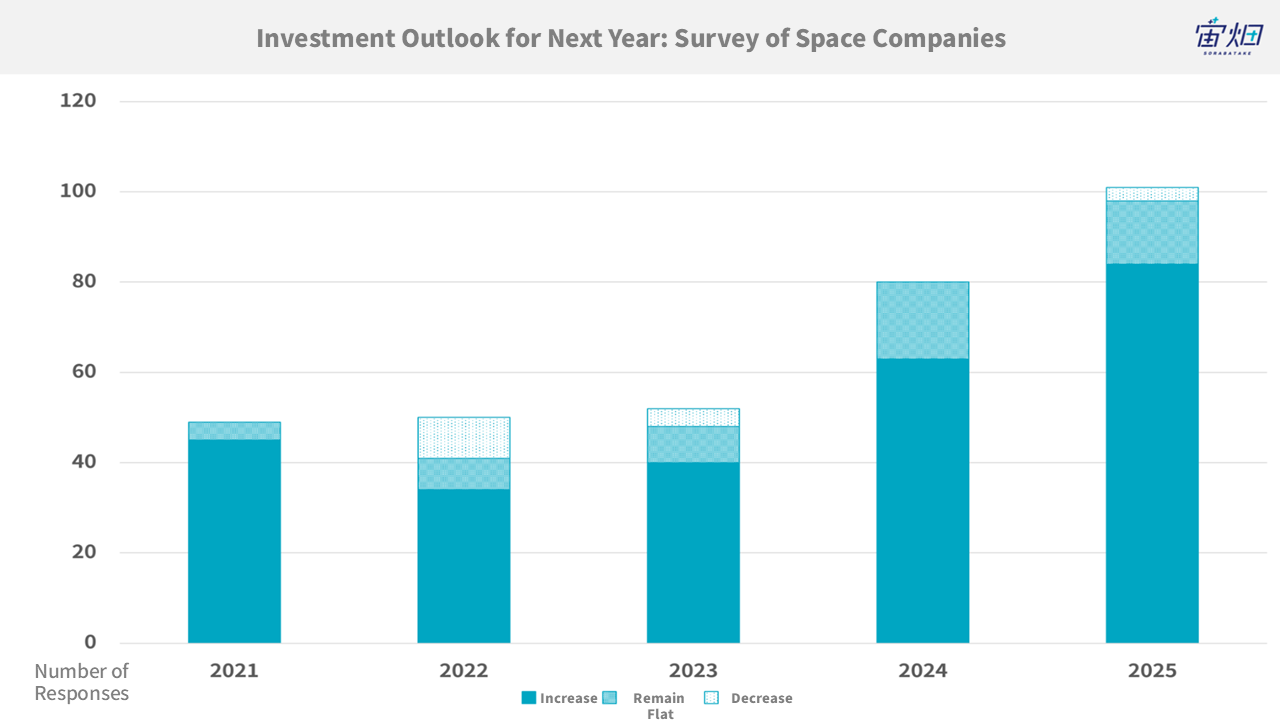
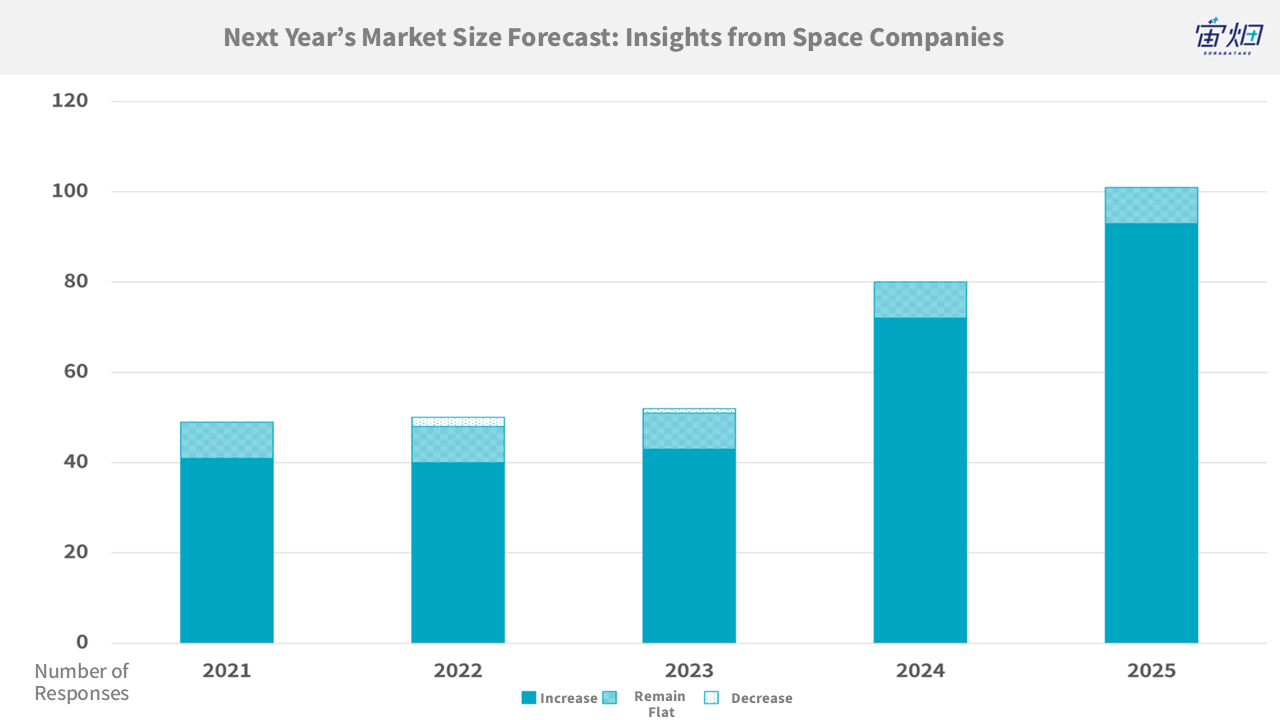
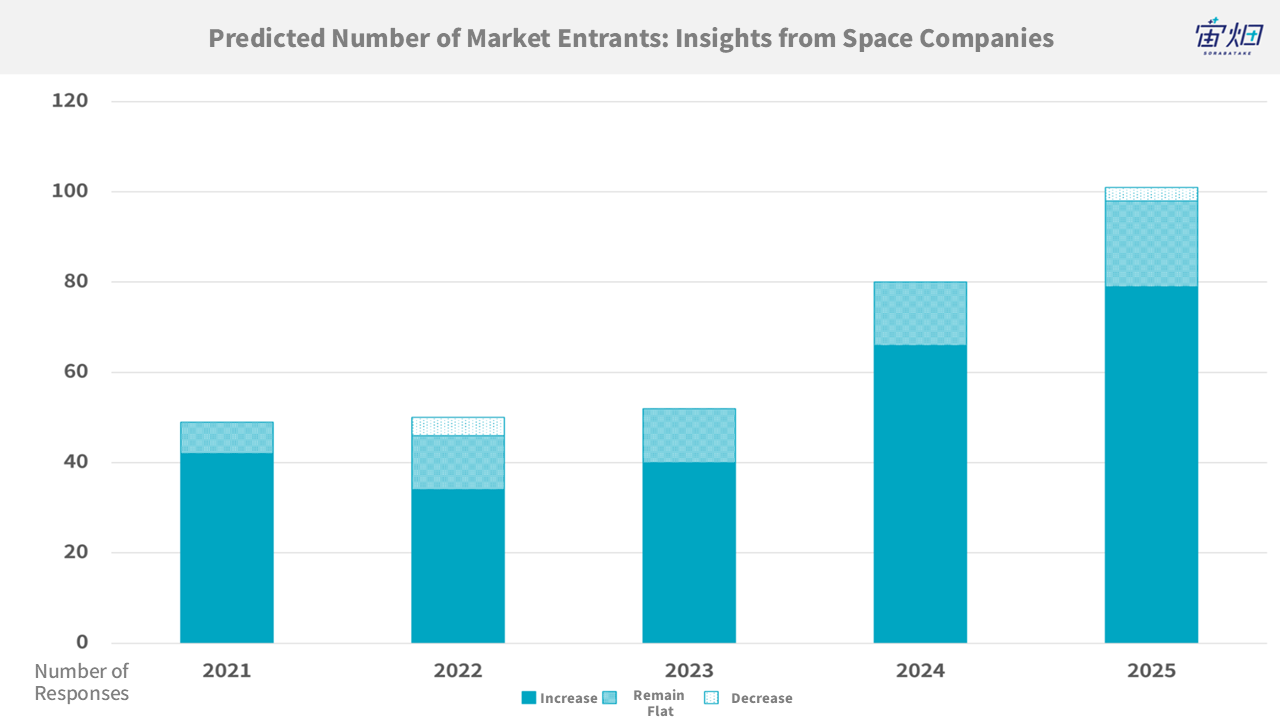
Since the 2021 survey, Sorabatake has annually asked companies to forecast the next year’s space business from three perspectives: investment amount, market size, and number of new entrants.
This year, we received responses from 102 companies, achieving the largest number of participating companies ever.
While the number of responding companies has increased, companies responding that business will trend upward from 2023 onward have shown an upward trend both in absolute numbers and proportions. This is considered to have created momentum to increase subsequent investments and participating companies through the Space Strategy Fund that began in 2024 and IPOs of major space venture companies such as ispace, iQPS, Astroscale, and Axelspace.
2026 will be the third year of the Strategy Fund, marking a year when the broad outline of fund usage becomes visible. Will R&D utilizing government funding show signs of generating international competitiveness and expanding business? And can this attract private investment as a core?
Whether the outcomes expected from the Space Strategy Fund will emerge, 2026 appears to be a turning point for the space business from 2027 onward.
Sorabatake will celebrate its 9th anniversary in February 2026, nine years since the site opened in February 2017. With the 10th anniversary approaching, we consider this a year to reflect once again on what we can do as a media outlet and what articles can support everyone, solidifying our foundation to realize the vision we set at site launch: “Making the space industry a core industry Japan can be proud of.”
Going forward, we will continue to create articles that can support those involved in the space business, those supporting Japan’s space industry, those planning to launch space businesses, and those considering jumping into the space industry to pursue their ambitions and goals. We look forward to your continued support.